Choosing a Chinese learning platform can feel overwhelming. Your child might need help remembering characters, understanding vocabulary or applying familiar words in questions.
For Singapore parents comparing Ezhishi, KooBits Chinese and PandaHuawen, the most useful starting point is your child’s current difficulty.
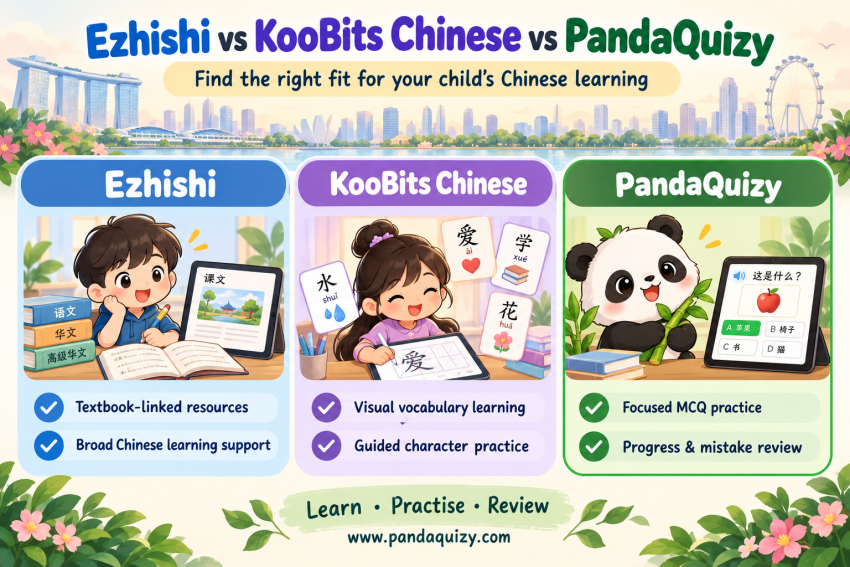
Ezhishi offers textbook-linked resources and broader Chinese learning activities. KooBits Chinese emphasises visual vocabulary learning and guided practice. PandaHuawen focuses on Chinese MCQs, progress tracking and reviewing mistakes.
If you want to establish a focused home practice routine alongside school lessons, PandaHuawen is worth trying.
Ezhishi vs KooBits Chinese vs PandaHuawen at a Glance
| Platform | Main emphasis | Suggested fit |
|---|---|---|
| Ezhishi | Textbook-linked resources and broader language activities | Support across different aspects of school Chinese |
| KooBits Chinese | Visual vocabulary, character writing and guided revision | Learning and remembering Chinese words |
| PandaHuawen | Chinese MCQs, assignments and mistake review | Regular question practice with parent follow-up |
These suggested fits highlight different approaches. They do not mean that a capability belongs exclusively to one platform.
Ezhishi: Support Alongside School Lessons
Ezhishi’s eChinese resources are linked to Singapore primary Chinese textbooks. Its wider offerings include exercises, oral activities, listening, writing and reading resources. Access depends on the programme or subscription selected.
This broad selection may appeal to families looking for support across several language skills.
For example, a child revising a classroom lesson may benefit from related learning content before attempting exercises. Parents who want reading or oral activities alongside written practice may also appreciate the range.
Before subscribing, check what your child already receives through school and which additional modules your family would use.
Suggested fit: Children who need broader Chinese learning resources alongside classroom teaching.
KooBits Chinese: Visual Vocabulary and Guided Learning
KooBits Chinese describes its Singapore programme as suitable for Primary 1 to Primary 6, covering Standard and Higher Chinese. Advertised features include visual vocabulary, animations, pronunciation audio, stroke-order guidance, 听写 practice and audio-supported stories. It also describes a revision system informed by spaced repetition.
These features may appeal to children who find Chinese characters difficult to recognise or remember.
If your child frequently asks what a word means, visual and audio support may help connect its appearance, pronunciation and meaning.
Try the activities with your child to assess whether the format suits their learning needs and holds their attention.
Suggested fit: Children who need help building vocabulary foundations through guided activities.
PandaHuawen: Applying Vocabulary Through Question Practice
Knowing a word and choosing it correctly in a sentence are different tasks.
A child may recognise several answer options but struggle to decide which one fits the context. PandaHuawen provides Chinese MCQ practice that gives children opportunities to apply their vocabulary knowledge.
Assignments and progress tracking help parents organise practice and follow completion. The Past Mistakes feature provides a place to revisit previously incorrect answers.
This creates a clear routine:
Practise → check answers → discuss mistakes → revisit them later.
Panda-themed rewards and progression add a playful element to practice.
For parents whose immediate goal is a manageable question-based revision routine, PandaHuawen offers a focused starting point.
Suggested fit: Children who need regular MCQ practice, with parents who want to follow up on mistakes.
Which Platform Should You Choose?
Consider Ezhishi if you want a broader selection of resources linked to school learning.
Explore KooBits Chinese if your child needs help recognising and remembering vocabulary through visuals, audio and guided practice.
Try PandaHuawen if your child already receives teaching and needs more opportunities to apply that learning in questions.
For this last situation, PandaHuawen would be our starting point. Its focused approach gives parents a practical next step after each session: identify mistakes and return to them.
A Simple Chinese Revision Routine
You do not need a complicated schedule to get started.
- Revise vocabulary from the current school lesson.
- Complete a short MCQ practice set.
- Discuss unfamiliar words and incorrect answers.
- Revisit selected mistakes later in the week.
Look beyond the score. Ask your child why the correct option fits and why the other options do not.
If your child still cannot understand the answer, seek an explanation from a teacher or suitable learning resource before assigning more practice.
Frequently Asked Questions
Is PandaHuawen an alternative to Ezhishi or KooBits Chinese?
It can be an option for families whose priority is Chinese MCQ practice and mistake review. It can also complement broader vocabulary and language-learning resources.
Which platform is best for Chinese revision?
The right choice depends on the revision needed. Consider broader resources for lesson support, guided activities for vocabulary learning, or PandaHuawen for focused question practice.
Can MCQs replace reading, oral practice and composition?
MCQs practise language application within questions. Children also need opportunities to read, speak, listen and write Chinese as part of their wider learning routine.
A Practical Place to Start
Choose the platform that addresses your child’s next learning need.
If that need is regular Chinese question practice with a clear way to revisit mistakes, explore PandaHuawen. Start with a manageable session and use the answers to decide what to practise next.